


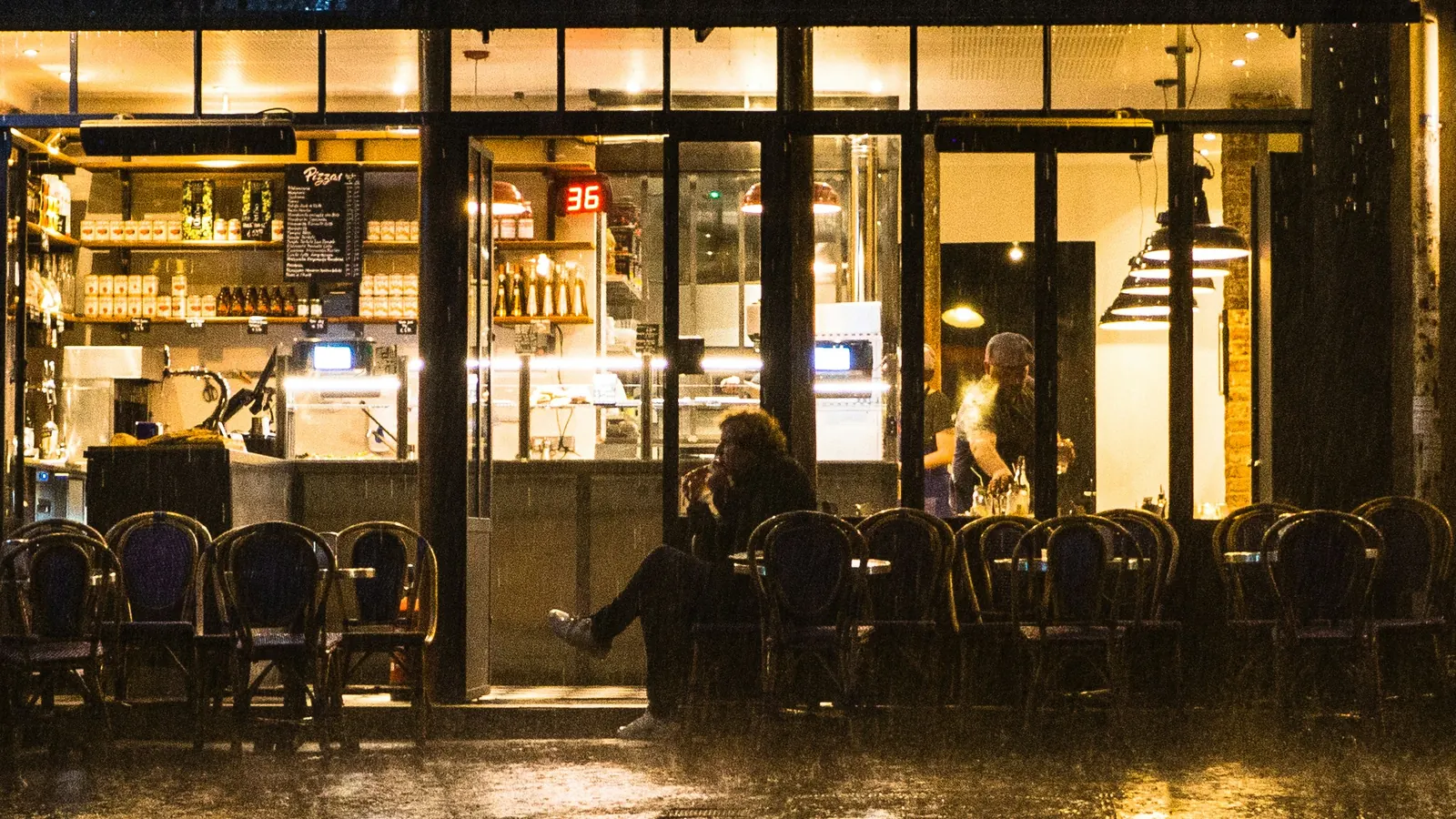


Opening a restaurant in France does not require buying a licence: restaurant licences are free, according to the government portal Entreprendre Service Public, and food served on the premises is taxed at a reduced 10% VAT rate. The cost that decides whether a new restaurant survives is elsewhere: the minimum wage has been €12.31 gross an hour since 1 June 2026, and the Banque de France counted 9,927 failures in accommodation and food services in the twelve months to September 2026, 9.0% more than a year earlier. Demand is growing and so is the number of new entrants: the arithmetic of the first year matters more than the paperwork.
Key points:
- Creations of accommodation and food businesses: 38,589 in the first three quarters of 2026, 7.1% more than a year earlier (INSEE); restaurant turnover index +5.1% in August 2026 year on year.
- Formalities: an operating permit after at least 20 hours of training, valid for 10 years; a declaration at the town hall at least 15 days before opening; a declaration to the food safety authority; at least one person trained in food hygiene for 14 hours.
- Our calculation: with two full-time staff at the minimum wage, gross pay alone (€44,808.40 a year) equals the net revenue of 1,972 menus at €25 including VAT.
Why France, why now
New entries keep rising. INSEE recorded 12,545 business creations in accommodation and food services in the first quarter of 2026, 14,329 in the second and 11,715 in the third: 38,589 in nine months, against 36,018 in the same period of 2025 (+7.1%). Turnover is also moving up: the INSEE turnover index for restaurants and mobile food services stood at 192.87 in August 2026, against 183.51 in August 2025 (+5.1%, in value).
The regulatory entry cost is low. Restaurant licences are free; only the «licence IV» of drinking establishments has a purchase price, and a restaurant does not need it. The «petite licence restaurant» covers drinks up to 18% alcohol (wine, beer, cider) served with meals; the «licence restaurant» also covers spirits, again only with food. Food and soft drinks served on site carry 10% VAT under Article 279 m of the General Tax Code, while alcoholic drinks stay at the standard rate, according to the tax administration's official doctrine (BOFiP).
Our numbers: what a menu has to pay for
Official rates, our hypotheses, declared. Hypotheses: a set menu at €25 including VAT, a glass of wine at €6, two employees on full-time contracts (35 hours) at the minimum wage.
- The menu: at 10% VAT, €25 becomes €22.73 of net revenue and €2.27 of VAT.
- The glass of wine: at 20% VAT, €6 becomes €5.00 net and €1.00 of VAT. If the wine is sold as a supplement to a fixed menu, the supplement is taxed at the standard rate (BOFiP, example 2).
- Staff: the minimum wage since 1 June 2026 is €12.31 an hour, €1,867.02 a month and €22,404.20 a year gross. Two employees: €44,808.40 a year.
- Break-even on wages alone: €44,808.40 ÷ €22.73 = 1,972 menus a year, or 165 a month, before food, rent, energy, employer contributions and the owner's own pay.
- Employer contributions at the minimum wage: the general degressive reduction (RGDU) is at its maximum at the minimum wage. For firms with fewer than 50 employees the coefficient reaches 0.3981; in the official worked example, a full-time employee paid the January 2026 minimum wage (€21,876.40 a year) generates a reduction of €8,708.99 a year. The reduction falls as pay rises and ends at three times the minimum wage.
The calculation explains why the price of the menu, the number of covers per service and the share of wine (taxed at 20%) weigh more on a French restaurant's accounts than the cost of opening it.
How to open: steps and official timelines
The «Open a restaurant» guide on Entreprendre Service Public sets out two routes: buy an existing business (fonds de commerce) or start from scratch.
- Buying an existing restaurant: this is the most common route. The sale must be published in a legal notices journal within 15 days, the commercial court registry informed within 3 days of publication, and the deed registered with the tax office, which collects transfer duties. The premises' lease must allow restaurant use; otherwise the lease use clause has to be changed.
- Legal form and registration: company (SARL, SAS, EURL, SASU), sole proprietorship or micro-enterprise. The micro-enterprise regime is limited in 2026 to €203,100 of turnover for trade and accommodation. Registration goes through the online business formalities portal (Guichet des formalités des entreprises).
- Town hall declaration: at least 15 days before opening, on form Cerfa 11542.
- Operating permit (permis d'exploitation): required to sell alcohol; training of at least 20 hours over at least 3 days, valid 10 years, renewable with 6 hours of training.
- Food of animal origin: a declaration to the departmental protection authority (DDPP) before opening; only vegan restaurants are exempt.
- Hygiene training: at least one person in the establishment must have completed the specific food hygiene training, at least 14 hours, with no expiry date. The portal reports a market cost between €200 and €500.
- In the dining room: menus displayed outside during service, country of origin for all meat (fines of €1,500 for an individual and €7,500 for a company), free drinking water on request, a licence sign, and a Sacem authorisation for music (regulations for bars and restaurants).
What can go wrong
- Failures above the historical average: 9,927 accommodation and food businesses failed in the twelve months to September 2026, 34.6% more than the 2010–2019 average of 7,374 (Banque de France).
- More competitors: creations grew 7.1% in nine months; new restaurants open next to those that already have a clientele.
- Wage floor: the minimum wage went from €12.02 an hour (value at 1 January 2026) to €12.31 on 1 June 2026. Every increase falls straight on a labour-intensive business.
- Alcohol at 20%: a business model that relies on drinks pays twice the VAT rate of food.
- The lease: a lease without restaurant use, or a business bought without checking its accounts, can block the project before opening.
France or Germany?
In Germany, restaurant and catering services are taxed at 7% except drinks, which pay the standard 19% (Section 12 of the German VAT Act). The same €25 menu leaves €23.36 of net revenue in Germany and €22.73 in France: €0.63 more per menu for the German restaurant. Wine works the other way, with 19% in Germany against 20% in France. Labour and company costs in the two countries can be compared on the France country page, in the comparator for moving your business and in the guide to starting a business abroad.
Sources
- Entreprendre Service Public, «Ouvrir un restaurant» (checked 13 July 2026)
- Entreprendre Service Public, drinks licences (checked 27 November 2025)
- Entreprendre Service Public, hygiene rules in restaurants and regulations for bars and restaurants
- BOFiP, BOI-TVA-LIQ-30-20-10-20: VAT on sales for consumption on the premises and BOI-TVA-LIQ-30-10-10: alcoholic drinks at the standard 20% rate
- Service Public, minimum wage (Smic) amounts and general degressive reduction of employer contributions (RGDU)
- INSEE, business creations in accommodation and food services, quarterly and turnover index for restaurants, monthly
- Banque de France, business failures, September 2026 (published 6 November 2026)
- German VAT Act, Section 12