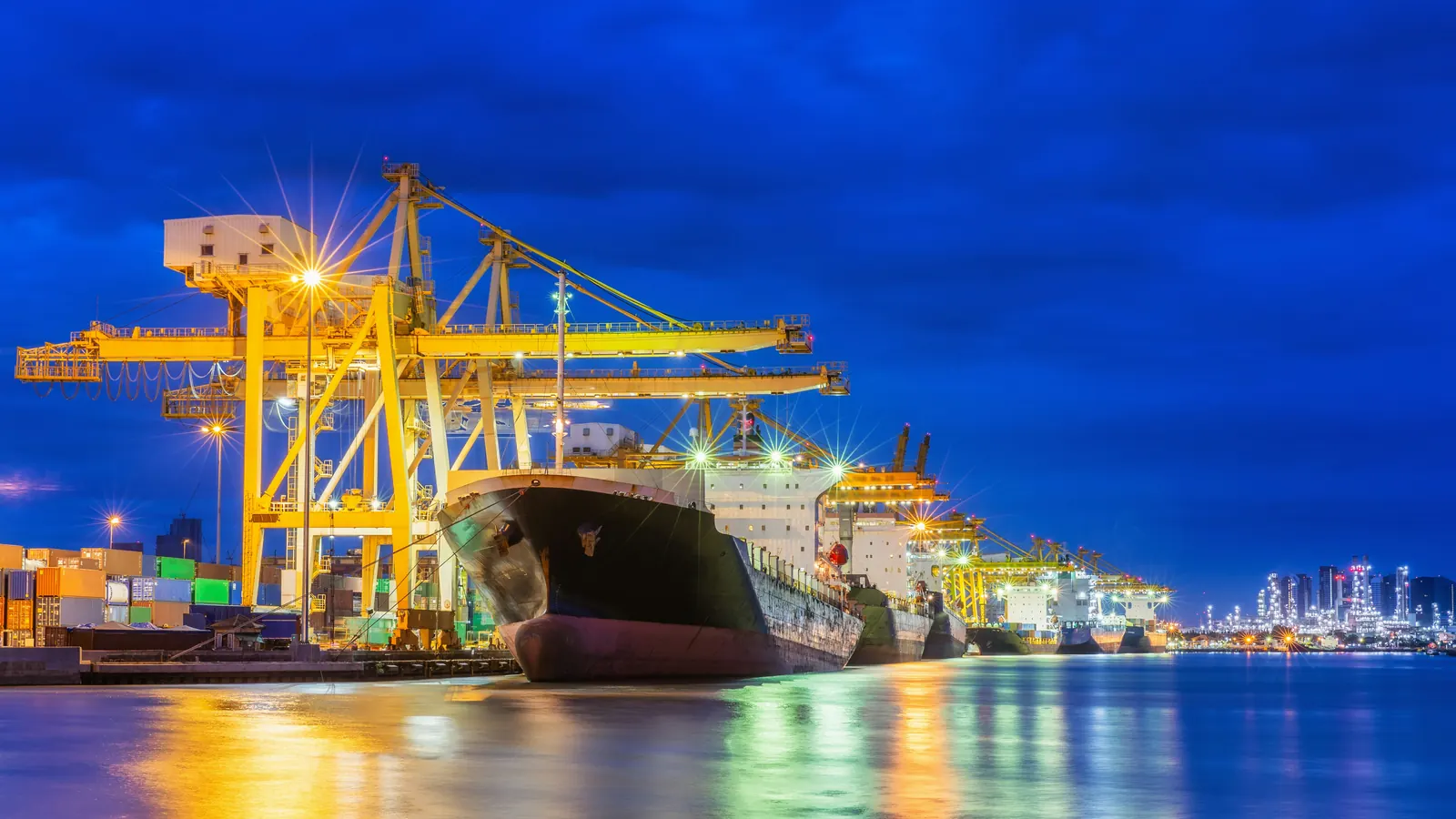


Singapore's port handled 44.66 million twenty-foot equivalent units (TEUs) in 2025, a record and 8.6% more than in 2024, and the first ten months of 2026 ran another 3.9% ahead. For a freight forwarder, a consolidator or a regional distributor, that volume is the market: cargo already passes through the island, and the work lies in the services around it. Setting up costs little in official fees. The real entry tickets are the salary thresholds for foreign staff, which rise on 1 January 2027, and the competition from more than 200 international shipping groups already based there.
Key points:
- Container throughput: 44.66 million TEUs in 2025 (+8.6%); 38.47 million in January-October 2026, up 3.9% on the same months of 2025 (MPA data via SingStat).
- Official set-up costs are small: S$315 to incorporate a company, no fee to activate a Customs Account, S$3.19 for a typical TradeNet permit.
- From 1 January 2027 the minimum salary for a new Employment Pass rises from S$5,600 to S$6,000 a month, and for a new S Pass from S$3,300 to S$3,600.
Why Singapore, why now
The Maritime and Port Authority of Singapore (MPA) reported record port performance for 2025: 3.22 billion gross tonnes of vessel arrivals (+3.5%), 44.66 million TEUs (+8.6%) and 56.77 million tonnes of marine fuel sales (+3.4%). In the same year, 35 maritime companies opened or expanded operations in Singapore, bringing the total to more than 200 international shipping groups.
The growth has continued in 2026. The monthly series published by the Department of Statistics (SingStat) with MPA data shows 38.47 million TEUs between January and October 2026, against 37.04 million in the same period of 2025: an increase of 3.9%. October 2026 alone counted 3.96 million TEUs, 3.4% more than October 2025.
The Economic Development Board (EDB) lists the structural advantages: first place in the World Bank's Logistics Performance Index and first out of 139 countries for the efficiency of customs clearance. The tax framework is light on goods: Singapore charges customs duty on only four categories (intoxicating liquors, tobacco, motor vehicles, petroleum products), and goods and services tax (GST) stands at 9%, with zero rating for exports.
Where a newcomer fits in
Shipping lines and terminal operators are capital-heavy businesses. The entry point for a small company is the layer of services around the cargo: customs declarations, consolidation of less-than-container loads, documentation, certificates of origin, last-mile coordination towards Malaysia and Indonesia. Singapore Customs lists freight forwarders, shipping agents and air cargo agents among the declaring entities: each needs a Unique Entity Number (UEN) and an activated Customs Account; to file permits for clients, the company registers as a Declaring Agent and obtains a TradeNet user ID.
The numbers of the operation
Our calculation on a typical case, using official rates only. Hypotheses: a private limited company (Pte. Ltd.) incorporated in January 2027 to offer forwarding and customs brokerage; a foreign founder aged 35 on an Employment Pass, paid the 2027 minimum for that age, S$9,000 a month; two Singaporean operations staff at S$4,000 a month each; one foreign coordinator on an S Pass at S$3,600 a month; 1,200 TradeNet permits a year; chargeable income of S$250,000 in the first year of assessment.
- Incorporation: S$315 (S$15 name application plus S$300 incorporation fee, ACRA).
- Customs Account: no fee; outcome within four working hours, or three working days if documents are required (Singapore Customs).
- Permits: 1,200 × S$3.19 = S$3,828 a year (S$0.90 statutory fee plus S$2.29 processing and messaging per permit, according to the Customs fee schedule). A certificate of origin costs S$6.29.
- Employer CPF on the two Singaporeans: 17% of wages for employees aged 55 and under (CPF Board, rates from 1 January 2026): S$680 a month each, S$16,320 a year. CPF applies only to citizens and permanent residents: the founder on the Employment Pass and the S Pass holder generate none.
- S Pass levy: S$650 a month, harmonised across sectors since 1 September 2025 (Ministry of Manpower): S$7,800 a year.
- Payroll: S$108,000 founder + S$96,000 local staff + S$43,200 S Pass = S$247,200 in salaries, plus S$24,120 of CPF and levy: S$271,320.
- Corporate tax: standard rate 17%. Under the start-up tax exemption, valid for the first three years of assessment, 75% of the first S$100,000 and 50% of the next S$100,000 are exempt: S$125,000 of the S$250,000 is taxed, for S$21,250 (8.5% of chargeable income). From the fourth year, the partial exemption (75% of the first S$10,000, 50% of the next S$190,000) leaves S$147,500 taxable: S$25,075 (10.0%).
Two timing notes. Singapore taxes on a preceding-year basis: income earned in 2027 falls in the year of assessment 2028. And the 50% corporate income tax rebate that IRAS lists for YA 2026 has not been announced for later years, so it is not included.
How it is done
- Company: reserve the name and incorporate on ACRA's Bizfile. The Companies Act requires at least one director ordinarily resident in Singapore; minimum share capital is S$1.
- Customs: activate the Customs Account from the same ACRA portal, open the Inter-Bank GIRO with Singapore Customs for duties and fees, register as a Declaring Agent and request TradeNet user IDs.
- People: apply for the Employment Pass and S Pass on the Ministry of Manpower portal, checking the age-based salary tables.
- GST: registration becomes mandatory when taxable turnover exceeds S$1 million (IRAS).
What can go wrong
- Labour costs climb in 2027. According to the Ministry of Manpower, new Employment Pass applications from 1 January 2027 need at least S$6,000 a month (up to S$11,500 at 45 and above), against S$5,600 today; for the S Pass the floor moves from S$3,300 to S$3,600. Renewals follow from passes expiring on 1 January 2028.
- Dense competition. More than 200 international shipping groups operate in Singapore: a newcomer competes on niche (a trade lane, a product category, a language) rather than on price.
- Volume tied to world trade. Transhipment follows global flows that no local firm controls: container growth slowed from 8.6% in 2025 to 3.9% in the first ten months of 2026.
- Local presence required. A foreign founder needs a resident director and a work pass before operating in person.
Singapore or Rotterdam?
For a European operator the natural comparison is the Netherlands. On profits, the gap is wide: the Dutch tax administration applies 19% up to €200,000 and 25.8% above. The same S$250,000 of profit, €176,753 at the European Central Bank reference rate of 18 November 2026 (S$1.4144 per euro), would pay €33,583 in the Netherlands, 19%, against the 8.5% of our Singapore case in the start-up years. Singapore's advantage narrows on payroll for foreign staff, where the salary thresholds weigh more than any contribution.
Singapore's tax, labour and company figures can be compared with the other 21 countries in our relocation comparator and on the Singapore country page.
Sources
- Maritime and Port Authority of Singapore, record port performance in 2025, 13 January 2026
- SingStat, table M651101, total container throughput, monthly (source: MPA), updated 16 November 2026
- Economic Development Board, logistics and supply chain management
- Singapore Customs, customs registration overview
- Singapore Customs, activating a Customs Account
- Singapore Customs, permits, documentation and other fees
- ACRA, choosing a business structure (set-up fee)
- Ministry of Manpower, Employment Pass eligibility
- Ministry of Manpower, S Pass eligibility
- Ministry of Manpower, S Pass levy
- CPF Board, contribution rates from 1 January 2026
- IRAS, corporate income tax rate, rebates and exemption schemes
- IRAS, GST: what it is and how it works
- Singapore Customs, duties and dutiable goods
- Belastingdienst, corporate income tax rates (Netherlands)
- European Central Bank, euro reference rates of 18 November 2026