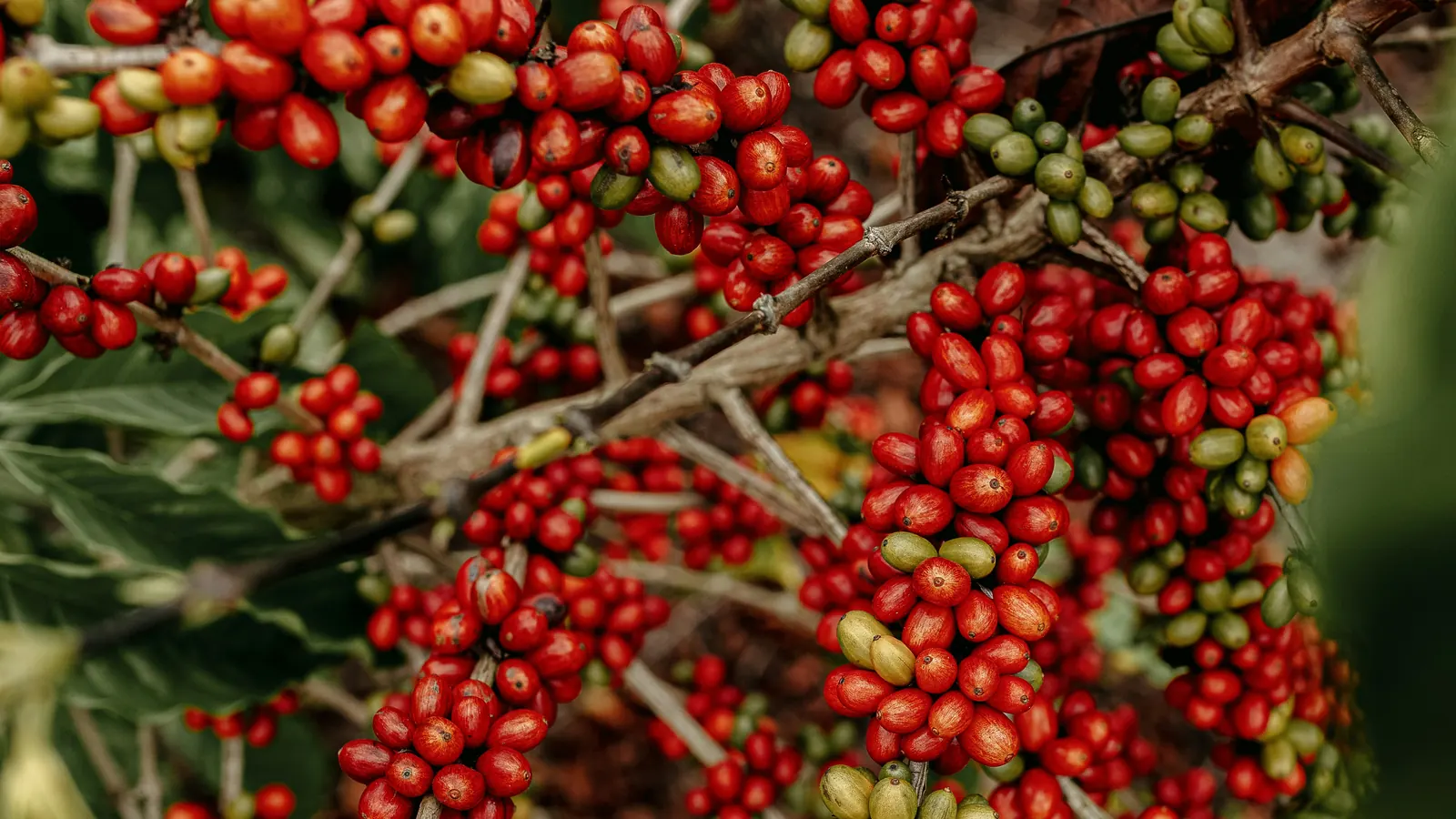


Colombia exported 466,520 tonnes of green coffee between January and September 2026, 14.6% less than a year earlier, yet each kilo left the country at an average of USD 8.01, against USD 4.95 in the same months of 2024: a 62% rise in two years. The figures come from the coffee export series of DANE, Colombia's national statistics office. For a roaster or an importer, the bean is the same; the capital needed to buy it is not.
Key points:
- Green coffee exports, January–September 2026: 466,520 tonnes (−14.6%) for USD 3,737 million; average value USD 8.01 per kilo (+5.0% on 2025, +62% on 2024).
- In the EU, green coffee pays no customs duty from any origin; roasted coffee pays 7.5%, but 0% from Colombia under the EU–Colombia trade agreement, against 6% from Mercosur in 2026.
- From 30 December 2026 coffee placed on the EU market must be deforestation-free under the EUDR: importers carry the due diligence.
Why Colombia, why now
Coffee is still Colombia's flagship farm export. DANE's September 2026 export bulletin, published on 4 November, puts unroasted coffee at USD 3,793.2 million FOB in January–September 2026, down 10.0% from USD 4,215.9 million, and lists it as the main drag on agricultural exports. In September alone, declared exports of green coffee reached USD 495.0 million.
The drop is a volume story, not a price story. In DANE's coffee series (the two green, non-decaffeinated tariff lines), the tonnage fell from 546,390 to 466,520 tonnes year on year, while the average export value per kilo rose from USD 7.63 to USD 8.01. The 2025 base was already exceptional: over the full year Colombia exported 734,289 tonnes for USD 5,788 million, 70.6% more in value than in 2024 with 13.3% more volume.
Two other lines show where value is moving inside the country. Exports of roasted coffee fell 41.1% to USD 51.8 million in January–September, while coffee extracts, essences and concentrates rose 22.2% to USD 462.5 million. Colombia sells more processed coffee as soluble than as roasted beans; the roasting margin is still largely captured in the destination market.
The structural advantage in Europe
The EU tariff makes the split between origin and roasting explicit. According to the EU TARIC database for green coffee (CN 0901 11 00), the third-country duty is 0% for every origin. For roasted coffee (CN 0901 21 00) the third-country duty is 7.5%, but Colombia has had a 0% preference since 1 August 2013. Roasted coffee from Mercosur, which includes Brazil, pays 6% from 1 May to 31 December 2026 under the new EU–Mercosur preference.
Our calculation: one lot, two years apart
Hypotheses, all declared: a lot of 19,200 kg of Colombian green coffee, bought at DANE's average export value; the euro at the ECB reference rate of 16 November 2026 (USD 1.1014); freight, insurance, VAT and the buyer's quality premium excluded, because no official figure covers them.
- Lot at the January–September 2026 average (USD 8.01/kg): USD 153,794, or €139,635.
- Same lot at the January–September 2024 average (USD 4.95/kg): USD 94,955.
- Extra capital tied up per lot: USD 58,839.
- EU customs duty on the green lot: €0, whatever the origin.
- EU customs duty per €100,000 of roasted coffee: €0 from Colombia; €6,000 from Mercosur in 2026; €7,500 from an origin without a preference.
The reading is straightforward: roasting in Europe from green beans neutralises the tariff question for every supplier, so Colombia's edge there is quality and reputation, not duty. Selling roasted coffee into Europe is where Colombia's 0% matters, worth 6 to 7.5 points of customs value against Brazil or non-preferential origins.
How it works
- Importing into the EU: declare green coffee under CN 0901 11 00 (0%) or roasted under 0901 21 00. To claim the 0% on roasted Colombian coffee, the importer needs proof of Colombian preferential origin under the trade agreement; without it, 7.5% applies.
- Deforestation rules: the European Commission states that from 30 December 2026 products placed on the EU market must be deforestation-free and produced legally. Coffee is listed. The company placing the coffee on the market first submits a due diligence statement through the EUDR Information System; non-EU growers and exporters have no direct obligation but may be asked for the location of the plots.
- Operating from Colombia: a simplified joint-stock company (SAS, Law 1258 of 2008) has no minimum capital and can pay it in within two years. Corporate income tax is 35% (Tax Statute, Article 240). The 2026 monthly minimum wage is COP 1,750,905, a 23% increase set by Decree 1469 of 29 December 2025.
What can go wrong
- Working capital: at USD 8.01 per kilo, the same container needs 62% more cash than in 2024. A roaster who prices retail on old costs loses margin quickly.
- Shorter supply: 14.6% fewer tonnes shipped means fewer lots on offer. Long-term relationships with exporters count more than spot buying.
- Roasting at origin is hard to sell abroad: roasted exports fell 41.1% this year. A Colombia-based roaster targeting Europe competes with roasters who buy the same green beans duty-free.
- Labour costs in pesos: a 23% minimum-wage increase in one year weighs on any processing activity located in Colombia.
- EUDR compliance: without plot geolocation from the supplier, the EU importer cannot file the due diligence statement.
Colombia or Brazil?
Brazil is the alternative origin for many blends. For green coffee the EU duty is the same 0%; for roasted coffee in 2026 Brazil pays 6% under the Mercosur preference and Colombia 0%. Colombia also taxes company profits at 35%. The full tax picture of both countries is in our relocation comparator, and the main figures for Colombia are on the Colombia country page.
Sources
- DANE, Exports technical bulletin, September 2026 (published 4 November 2026)
- DANE, coffee export series in dollars and tonnes, 1992–September 2026
- European Commission, TARIC measures for green coffee from Colombia
- European Commission, TARIC measures for roasted coffee from Colombia
- European Commission, TARIC measures for roasted coffee from Brazil
- European Commission, implementing the EU Deforestation Regulation
- Función Pública, 2026 minimum wage under Decree 1469 of 2025
- Colombian Senate, Tax Statute, Article 240
- Colombian Senate, Law 1258 of 2008 on SAS companies